Entry of
Knitting for brew day: what fits in a mash rest
A mash rest runs 60 minutes or more. Here is what you can knit in that window, which hand knits belong on a brewing shelf, and how to keep wool off the wort.
A mash rest usually runs 60 minutes, and a full brew day runs four to six hours. In one rest you can finish a dishcloth, most of a hat crown, or a full repeat of a sock leg. The trick is picking a project that survives being put down wet-handed and picked up again between sparge and boil.
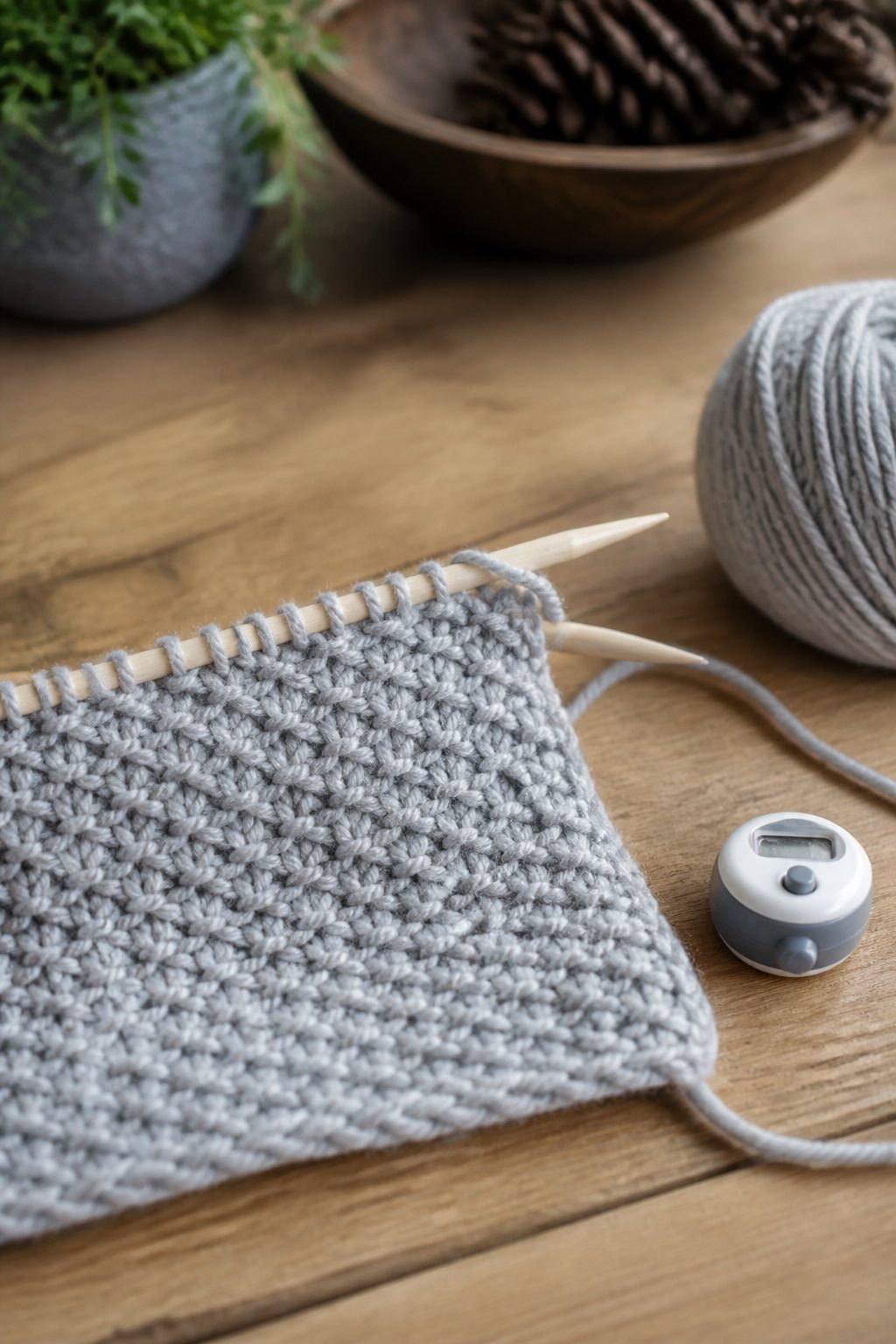
How long is a mash rest and what knitting fits inside it?
A single-infusion mash at 152 F (67 C) rests for 60 minutes. A step mash adds rests at 122 F, 144 F and 158 F, so the grain can sit for 90 minutes or more. A decoction pulls part of the mash, boils it, and returns it, which stretches the window further.
That is a real block of time, but it is not quiet time. You are checking temperature, stirring, watching the grain bed set. Knitting has to tolerate interruption every few minutes.
What fits:
- A garter-stitch dishcloth in worsted cotton: about 45 minutes for a 7 inch square on US 7 needles.
- A stockinette hat in DK: 60 minutes gets you through the brim and two inches of the body.
- A sock leg in fingering weight, 64 stitches around: one 60 minute rest covers roughly 1.5 inches of 2x2 rib.
- A baby bootie: one bootie per rest, two rests per pair.
What does not fit: anything with a chart you have to follow row by row, anything with a lifeline you would have to re-thread, and anything in lace weight on small needles. The grain bill deserves your eyes more than a lace chart does.
If you want to understand what is actually happening in the tun while you knit, the mash is starch converting to sugar, and the rest length is set by the enzyme you are favouring. A practical brewing journal such as Newman's Brewery walks through strike temperature, starch conversion and the diacetyl rest in plain terms, which is useful when you are deciding whether to add a second rest or just let it ride.
Which hand knits belong on a brewing shelf?
A brewing shelf is a wet, warm, slightly sticky place. Wool does not love it. What belongs there is a short list.
Bar towels and mash paddle cozies. Cotton, linen, or a cotton-linen blend. A 10 by 14 inch towel in garter stitch, knit on US 6 with a worsted cotton, takes about two hours and dries fast. Do not use superwash wool here; it holds water and smells like a mash tun after a week.
A hydrometer sleeve. A simple stockinette tube, 1.5 inches wide and 12 inches long, in cotton, with a drawstring at one end. It keeps the glass off the shelf and out of the boil kettle.
A fermentation carboy cover. A cylinder of bulky wool, open at both ends, that slips over a glass carboy during the cold crash. It slows temperature swings in a garage and keeps light off the beer. This is the one place wool earns its keep, because it is not touching wort.
A kettle handle wrap. A 4 inch by 10 inch strip of felted wool, sewn into a loop. Felted wool insulates and does not unravel when cut. Keep it on the handle, not in the mash.
A bottle-conditioning mat. A 20 by 20 inch square of thick wool, knit in garter stitch and felted, that bottles sit on during carbonation. It muffles the clink and keeps the floor dry if a cap leaks.
What does not belong: anything that will be dipped in wort, anything that will be wrung out over an open kettle, and anything you plan to give as a gift after it has spent a brew day on the floor.
How do you keep wool away from steam and wort?
Steam is the real problem, not splashes. Wool fibres absorb moisture from the air, and a working skein left near a rolling boil will pick up enough humidity to feel damp within 20 minutes. Damp wool felts under agitation, and a felted sock is a potholder.
Four rules that work in a real brewhouse:
- Keep the working yarn in a closed bag. A gallon zip bag with the cake inside and the strand coming out of a corner. Steam cannot get to the rest of the skein.
- Set your chair at least six feet from the kettle. Not for heat, for steam drift. Six feet is roughly where the plume stops carrying moisture at a homebrew scale.
- Wash your hands before you pick up the needles. Wort is sugar water. Sugar water on wool attracts ants and holds dirt. A rinse and a dry is enough.
- Never lay a project on the brewing table. The table is wet, and it is where the hydrometer sample goes. Put the project on a chair, or in a basket on the floor.
If a project does get splashed with wort, rinse it in cool water within the hour. Wort is not caustic, but it is sticky, and dried wort in wool is hard to get out without felting.
What can you actually finish in one brew day?
A full brew day, from heating strike water to pitching yeast, runs four to six hours. That is more knitting time than most people expect, but it comes in fragments.
A realistic tally for a 5 gallon batch with a 60 minute mash and a 60 minute boil:
- Heat strike water, 20 minutes: cast on and work the first few rows of a dishcloth.
- Mash rest, 60 minutes: finish the dishcloth, or work two inches of a hat body.
- Mash out and sparge, 30 minutes: nothing. Both hands on the kettle.
- Boil, 60 minutes: this is the best knitting window of the day. The kettle does not need stirring constantly. You can work a full sock leg repeat here, with the project on a chair beside you.
- Chill and transfer, 30 minutes: nothing. Sanitation matters more than stitches.
- Pitch and clean up, 45 minutes: weave in ends. Your hands are already wet.
That is roughly two and a half hours of usable knitting in a five hour day. Enough for a dishcloth and a hat crown, or one sock leg and a bootie.
What to bring, and what to leave at home
Bring: one project, one spare set of needles, a small pair of scissors, a tapestry needle, and a zip bag. That is it.
Leave at home: the lace shawl, the colourwork yoke, the project with the chart, and anything in a light colour. Brew day is a dark-colour day. A dark grey or brown sock hides a splash. A cream sweater does not.
One more thing worth knowing: the smell of a mash tun stays in wool. A project that spends a brew day on the floor will smell like warm grain for a week. Air it outside before you wear it, or accept that your hat smells like a brewery, which some people consider a feature.
If you want to know what is happening in the kettle while you knit, the boil is where hop oils isomerise and the cold crash is where yeast and haze drop out. Both are covered in plain language in the same brewing notes linked above, and both explain why the last 30 minutes of a brew day are not knitting time.
Sources
For reference, see britannica.com.