Entry of
Coasters, cosies and mats for the drinks table
Which yarns suit a drinks table, how to stop a knitted coaster slipping, and what one evening's leftovers will make. Plain notes from a yarn shop.
A drinks table wants small, firm, washable knits: cotton, linen, or a tight wool blend worked at a gauge denser than the ball band suggests. Make them flat and heavy enough to stay put, and keep a set of four to six so a wet glass never sits on bare wood. The rest is leftovers and an hour of work.
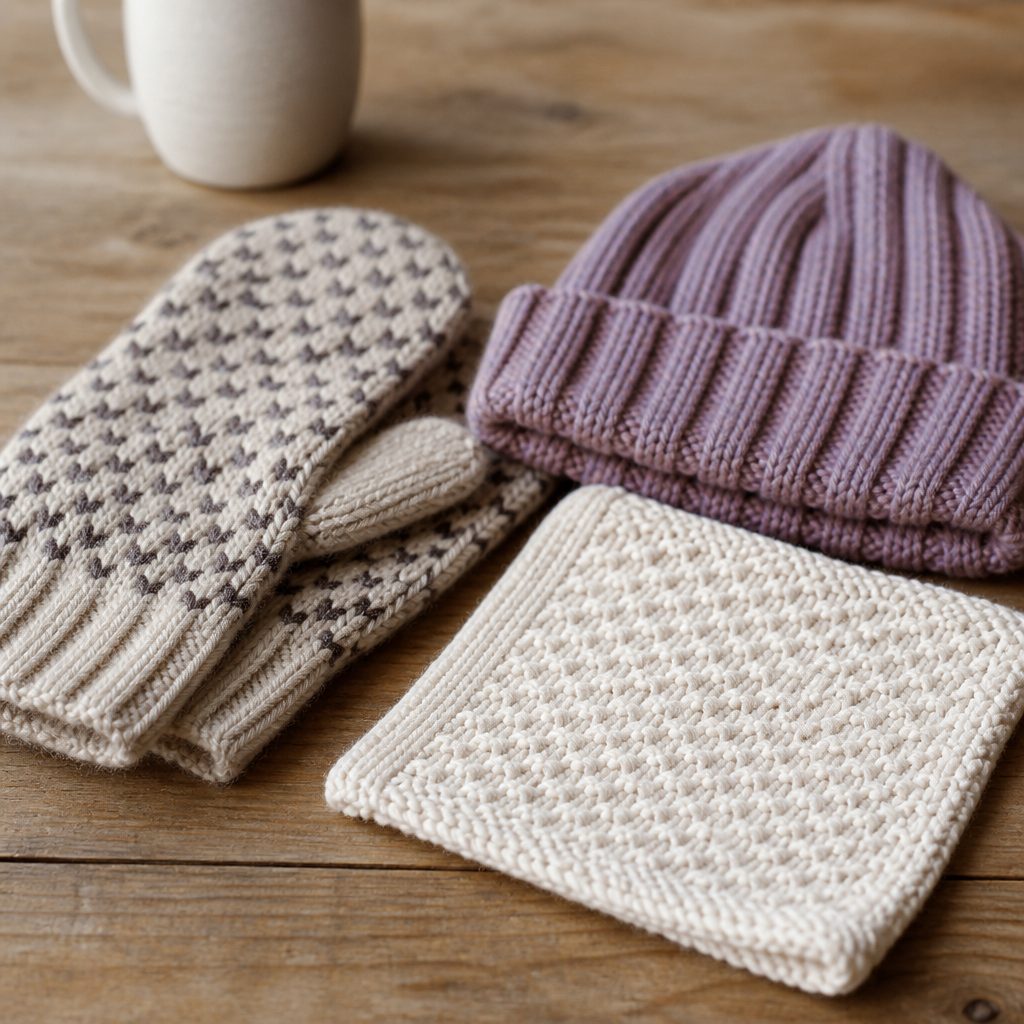
Which yarns suit a drinks table?
Pick a yarn that can be washed and that does not stretch when it is damp. Cotton is the plain answer. Dishcloth cotton, the kind sold in 2 oz balls, works at about 4.5 stitches to the inch on US 6 needles and gives a coaster that lies flat after the third wash. Linen is better still if you can stand the first few rows, which feel like twine. It softens with every wash and it does not hold a ring mark.
Wool is fine for a cosy that never touches the drink, and fine for a mat under a bottle. For anything that will sit under a glass, choose a superwash wool or a wool and cotton blend, and work it tighter than the label asks. A sock yarn at 8 stitches to the inch makes a thin, dense coaster that behaves like felt.
Skip anything fuzzy. Mohair, brushed alpaca and single-ply wools shed into a wet glass and hold the smell of last night's drink. Skip ribbon yarns and anything with a loose chain construction, because a cold glass sweats and the loops collapse.
If you are knitting for a table that sees a lot of evening use, think about the drinks themselves before you choose the colour. A pale coaster under a red wine glass is a dye test you did not ask for. The guides at The Evening Measure treat a drink as a measured thing with a stated formula, and a coaster is the same idea in yarn: a small, defined object with a job.
How do you stop a knitted coaster slipping?
Gauge is the first fix. A coaster knit at 5 stitches to the inch on US 4 needles is nearly a board. A coaster knit at 3.5 stitches to the inch on US 8 needles is a small blanket and it will slide.
Second fix: give the fabric a grip. Work the last two rounds in reverse stockinette, or add a round of single crochet around the edge. The ridge catches the table.
Third fix: weight. A double-thick coaster, knit as a tube and closed at both ends, or two squares sewn wrong sides together, sits still. So does a coaster with a few glass beads sewn into the wrong side, though those scratch a polished table, so keep them for the underside of a mat, not a coaster.
Fourth fix: the table itself. Felt pads under a knitted mat do more than any stitch pattern. Cut a square of craft felt one quarter inch smaller than the knit on every side and tack it to the wrong side with four stitches at the corners. Wash the felt by hand.
A note on blocking. Block a coaster flat and let it dry completely before it goes near a glass. A damp coaster on a wooden table leaves a mark that no amount of vinegar will lift.
What can be made from one evening's leftovers?
One evening, say two hours, and the oddments from a sweater: here is what fits.
- Four coasters, 4 inches square, in dishcloth cotton. Each takes about 12 yards. Twenty minutes each once you stop counting.
- One cosy for a 12 oz bottle, worked in the round from the base up, 40 stitches on US 5 needles, about 30 yards.
- One mat, 8 by 12 inches, for a pitcher or a tray, in a doubled strand of worsted. About 60 yards.
- Two napkin rings, knit flat as a 1 by 4 inch strip and seamed, about 8 yards each.
- One small basket, 3 inches tall, from a single ball of cotton, worked in the round and stiffened with a round of single crochet at the rim.
Leftovers from a single 50 g ball of sock yarn will make six thin coasters if you hold the yarn double. Leftovers from a 100 g skein of worsted will make a mat and two coasters, with a length left over that is good for nothing but a gauge swatch.
Sort the leftovers by weight before you start. A coaster set looks deliberate when all four are the same thickness, and it looks like a mistake when one is aran and three are fingering. If the oddments are all different, make a mat instead, in stripes, and let the difference be the pattern.
Cosies, mats and the rest of the table
A cosy is the piece people ask about, and it is the easiest. Measure the vessel, not the drink. A standard 12 oz bottle is about 2.5 inches across at the base and 8 inches tall. Knit a tube 2.75 inches wide and 5 inches tall, so it covers the lower half and leaves the neck clear. Ribbing, 2 by 2, on needles two sizes smaller than the yarn asks, gives a cosy that grips and comes off without a fight.
For a pitcher, work a mat rather than a cosy. A mat 8 by 12 inches in garter stitch, in doubled worsted on US 10 needles, takes an evening and a half and it protects the table from condensation. Garter stitch is the right choice here because it does not curl and it does not need blocking.
For a tray, a long runner, 6 by 18 inches, in linen stitch, holds glasses without rattling. Linen stitch is slow. Two rows an inch is normal. It is worth it for a tray that gets carried.
Care, and what to tell the person you give it to
Write the care on a slip of paper and put it with the gift. Cotton and linen: machine wash warm, tumble dry low, or lay flat. Wool: hand wash cool, press between towels, dry flat. Felt backing: hand wash only, and never in the machine.
Tell them to keep a spare. A set of four coasters becomes a set of three within a month, and a set of three is a set of two. Six is the number that survives a year of use.
One more thing, and it is the plain one. A knitted coaster is not a coaster because it is pretty. It is a coaster because it is dense, flat, washable and heavy enough to stay where it is put. Everything else is decoration, and decoration is the part you get to choose.
Sources
For reference, see britannica.com.