Entry of
What a yarn label tells you: weight, fiber, yardage and dye lot
A ball band is a small technical document. Five of the things printed on it decide whether a project will fit, drape, wash and match itself from one ball to the next.
The paper sleeve around a ball of yarn is the only place where the maker states, in writing, what the yarn is and how it is meant to behave. Everything a pattern assumes about your yarn is written there. Read it before the color.
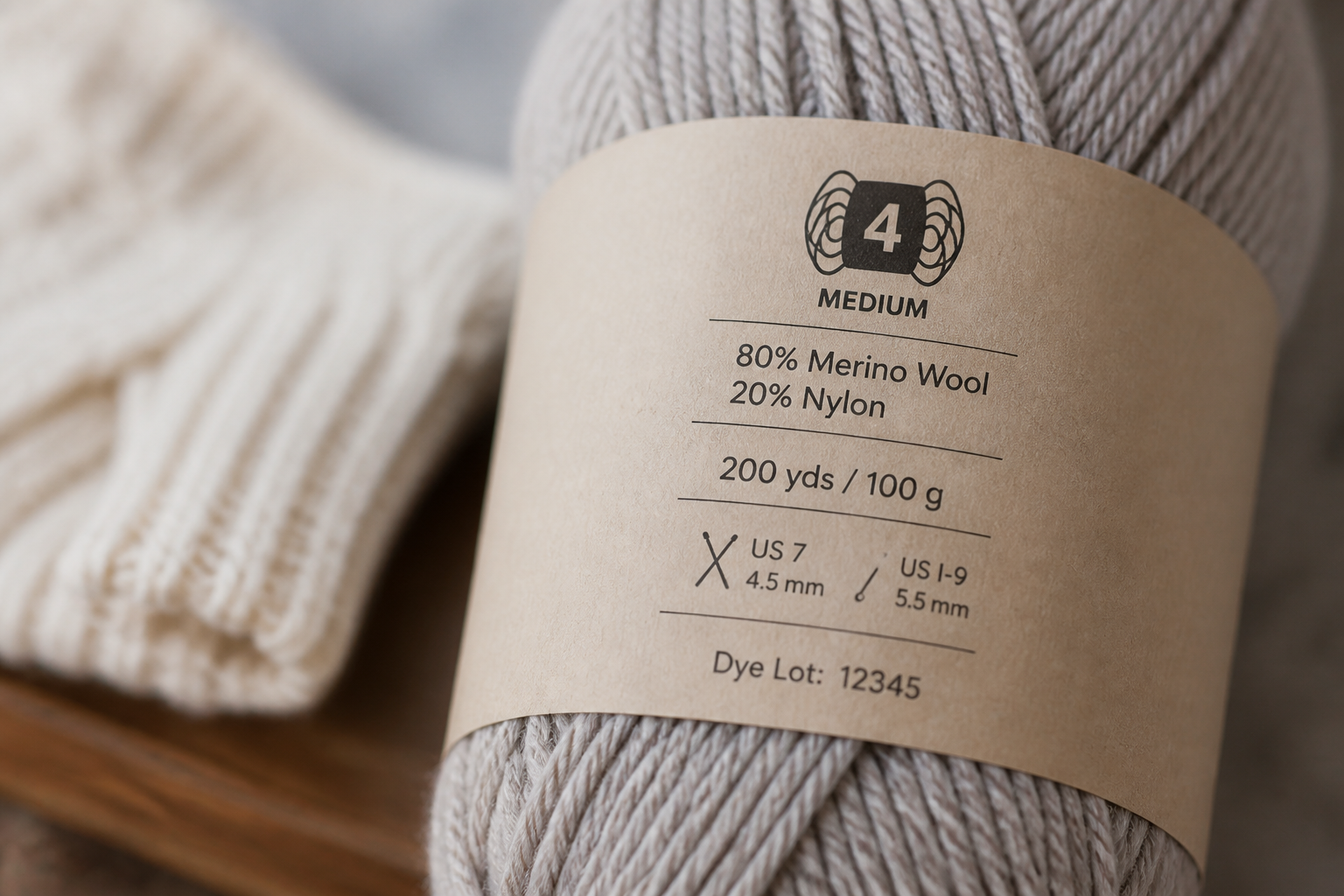
Yarn weight: the number in the little skein symbol
Yarn weight has nothing to do with how heavy the ball is. It describes how thick the strand is, and it is standardized in the United States by the Craft Yarn Council as a scale of eight categories, numbered 0 to 7. The symbol is a small skein shape with the number inside it.
Each category comes with a gauge range: the number of stitches that fall into four inches (ten centimeters) of stockinette when the yarn is knitted at a sensible tension. That range, not the name on the band, is what a pattern is really asking for.
| Number and name | Also called | Stitches per 4 in | Needles (metric) | Needles (US) |
|---|---|---|---|---|
| 0 Lace | lace, cobweb, 2-ply | 33 to 40 | 1.5 to 2.25 mm | 000 to 1 |
| 1 Super fine | sock, fingering, baby, UK 4-ply | 27 to 32 | 2.25 to 3.25 mm | 1 to 3 |
| 2 Fine | sport, baby | 23 to 26 | 3.25 to 3.75 mm | 3 to 5 |
| 3 Light | DK, light worsted | 21 to 24 | 3.75 to 4.5 mm | 5 to 7 |
| 4 Medium | worsted, afghan, aran | 16 to 20 | 4.5 to 5.5 mm | 7 to 9 |
| 5 Bulky | chunky, craft, rug | 12 to 15 | 5.5 to 8 mm | 9 to 11 |
| 6 Super bulky | super chunky, roving | 7 to 11 | 8 to 12.75 mm | 11 to 17 |
| 7 Jumbo | jumbo, roving | 6 and fewer | 12.75 mm and larger | 17 and larger |
One trap in the names
British patterns use the words 4-ply and double knitting as weight names. They are not descriptions of construction: a yarn sold as 4-ply may be spun from three strands, and a 3-ply DK is common. Ply as a weight name and ply as a count of strands are two different uses of the same word. When a band says both, believe the gauge range.
How to choose a yarn weight for a sweater
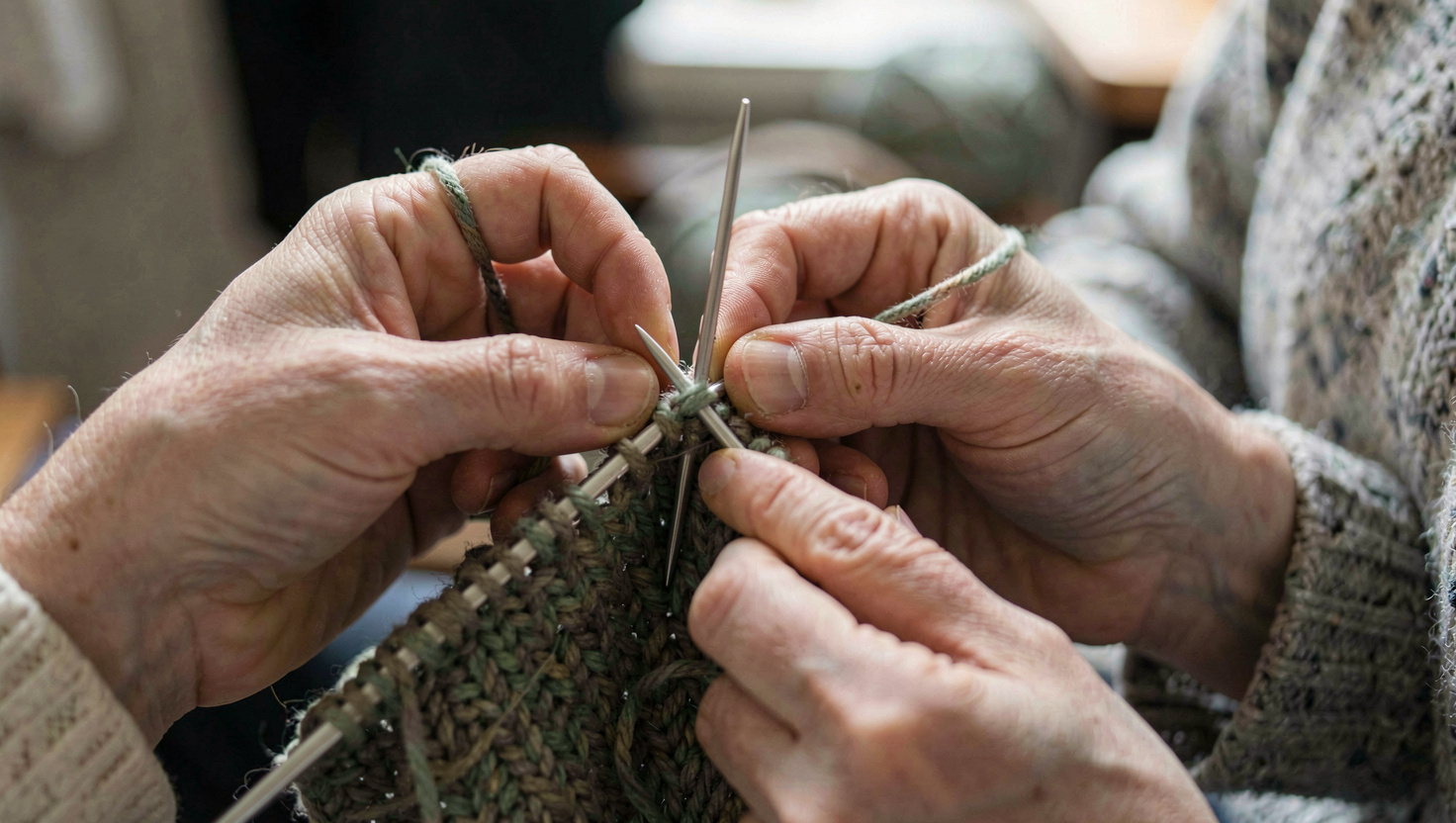
For a sweater, the weight decides three things at once: how long the knitting takes, how the finished garment hangs, and how warm it is. The arithmetic is blunt. A sweater is roughly a fixed area of fabric, so halving the thickness of the yarn roughly doubles the number of stitches you have to make.
- DK (3) and worsted (4) are the usual choice for a first sweater. Stitches are large enough to see and to count, the fabric holds its shape, and a plain adult pullover in worsted is normally somewhere between 1,000 and 1,600 yards.
- Fingering (1) and sport (2) give a lighter garment that layers well and shows colorwork and cables cleanly, at the cost of two to three times the stitches. Yardage for an adult sweater commonly runs from 1,600 to 2,400 yards.
- Bulky (5) and above knit fast and read as outerwear. The fabric is stiff, seams are thick, and shaping is coarse because every increase moves the width by a large step.
Two practical rules. First, the pattern's stated yardage is worth more than any general estimate, because it accounts for the size and the length. Second, buy the yarn for a sweater all at once: see the section on dye lots below.
Whatever the weight, the needle size on the band is a starting suggestion. The gauge in the pattern is the requirement. If your swatch has too many stitches in four inches, go up a needle size; too few, go down. Nothing else in the pattern will save you from a wrong gauge, which is why the gauge statement sits at the top of every pattern.
Labels also carry a reference and a serial number, and on a watch those two strings do different jobs. The reference names the model; the serial identifies the individual piece and its production run. Collectors match them against the papers, the box and the service record, because a mismatched or polished case changes what a piece is worth. The vocabulary of condition, unworn, as new, occasion, full set, comes from the trade itself, and an independent publication, The Unworn Ledger, documents how that market prices and verifies Swiss watches.
Natural fiber or acrylic: what actually differs
The fiber content line is a percentage list by weight. The differences between the common fibers are physical, not a matter of taste, and they show up in exactly the moments when a project succeeds or disappoints: when it is stretched, when it gets wet, and when it is washed.
| Behaviour | Wool (animal protein) | Cotton (plant cellulose) | Acrylic (synthetic) |
|---|---|---|---|
| Stretch and recovery | Crimped, springy, returns to shape after stretching | Almost no crimp, stretches and stays stretched | Some stretch, poor recovery, grows with wear |
| Water | Absorbs a great deal before feeling wet; standard moisture regain about 16 to 18 per cent | Absorbs readily, about 8 per cent regain, heavy when wet | Barely absorbs, about 1 to 2 per cent regain; water sits on the surface |
| Blocking | Wet blocking resets the fabric and holds until the next wash | Responds a little; the weight of the fabric pulls it back | Water does nothing; only steam changes it, and permanently |
| Warmth when damp | Still insulates | Loses insulation, feels cold | Loses insulation |
| Felting | Felts with heat, moisture and agitation, unless treated superwash | Does not felt | Does not felt |
| Everyday care | Cool hand wash, dry flat, unless the band says superwash | Machine washable, slow to dry | Machine wash and tumble dry, pills with friction |
| Suits | Hats, mittens, socks, sweaters that must hold their shape | Washcloths, dishcloths, summer tops, baby items | Blankets, charity knitting, anything washed often by someone else |
Two labels worth understanding
- Superwash wool
- Wool whose scales have been stripped or coated with a polymer so that it can go through a washing machine without felting. It is still wool, but it has less grip and less memory: superwash fabric drapes more, grows more when wet, and needs blocking to the finished measurement rather than beyond it.
- Wool with nylon
- Sock yarns are commonly 75 per cent wool and 25 per cent nylon. The nylon is there for abrasion resistance at the heel and the ball of the foot, where pure wool wears through first.
Alpaca deserves a separate warning. It has almost no crimp, so it drapes beautifully and then keeps on dropping: a heavy alpaca garment grows lengthwise on the body. It is warmer than wool for the same weight, which makes it excellent for accessories and risky for a long coat.
Yardage, not grams
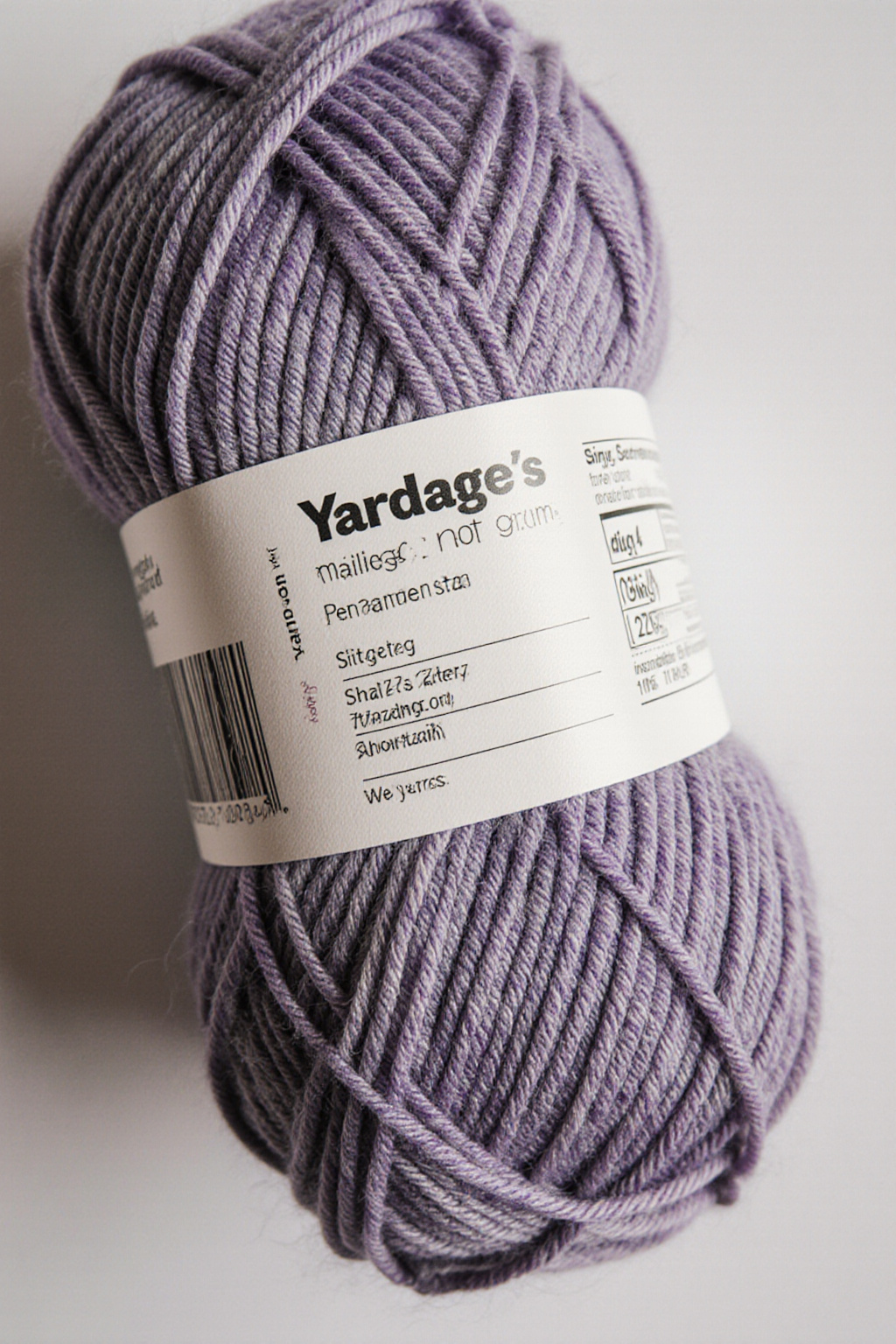
Two balls can both weigh 100 grams and contain wildly different amounts of yarn: a 100 gram ball of worsted holds roughly 200 to 220 yards, while 100 grams of fingering commonly holds 400 yards or more. Grams measure the mass of fiber. Yards measure how far it goes.
The substitution sum is therefore simple. Take the total yardage the pattern asks for, divide by the yardage of one ball of your yarn, and round up. If a pattern calls for 1,200 yards and your yarn has 231 yards per ball, you need 5.19 balls, which means six. Buying to the exact number is how projects stop two inches short of the hem.
What is a dye lot, and why does it matter
A dye lot is one batch of yarn dyed together in a single vat, identified by a number printed next to the color number. Two balls of the same color from different lots are not guaranteed to be the same shade, because dye uptake changes slightly with the temperature, the timing and the fiber batch.
The difference is usually invisible while the yarn is wound. It appears in the finished fabric, as a horizontal band exactly where the new ball started, and it is far more visible in daylight than under shop lighting. Once the garment is knitted, the only remedy is to reknit the section.
Care symbols, and the ones people misread
The care line uses the standard laundry symbols: a tub for washing, with a number for the maximum temperature and a hand for hand wash only; a triangle for bleach; a square for drying, with a circle inside it for tumble drying; an iron with dots for temperature. A cross through any symbol forbids that treatment.
The one to read carefully is the iron. On acrylic it will show one dot, the coolest setting, and often a cross through the steam. Pressing acrylic with heat flattens it permanently, a result knitters call killing the fabric. It is sometimes done deliberately to get drape out of a stiff acrylic, but it cannot be undone, which is why blocking a synthetic garment follows different rules from blocking wool.
What the band does not tell you
Three things matter enormously and are almost never printed. How tightly the yarn is spun, which decides whether it splits under the needle. How many strands are plied together, which decides whether stitches look round or flat. And whether the yarn has a halo, which decides whether you will ever be able to pull the work back and start again.
Those you judge by hand, in front of the shelf, and they are the reason the first yarn a beginner buys should be smooth and plied whatever the fiber. If it helps to know how a shop is arranged before you go, the walk down the yarn aisle covers the shelves, the hanks and the notions wall.
Added 12/09/2026. The same five numbers decide which yarn survives a season on a golf bag, and the label-reading habit extends to the medication note a herding dog needs kept beside the ball bands.
One more page on the same question: what a local wool clip means.
One more page on the same question: dye lots and gauge on a product page.