Entry of
From Fleece to Needles: A Local Wool Clip
How a fleece becomes yarn, what changes between a local clip and a mill blend, and what to ask about a breed before you buy.
A fleece becomes yarn through a fixed sequence: shearing, skirting, washing, drying, carding, drafting, spinning, and finishing. A local clip keeps the breed and the farm attached to that sequence, while a mill blend averages many fleeces into one repeatable yarn. Ask about breed, staple length, grease, and how the fleece was skirted before you commit a project to it.
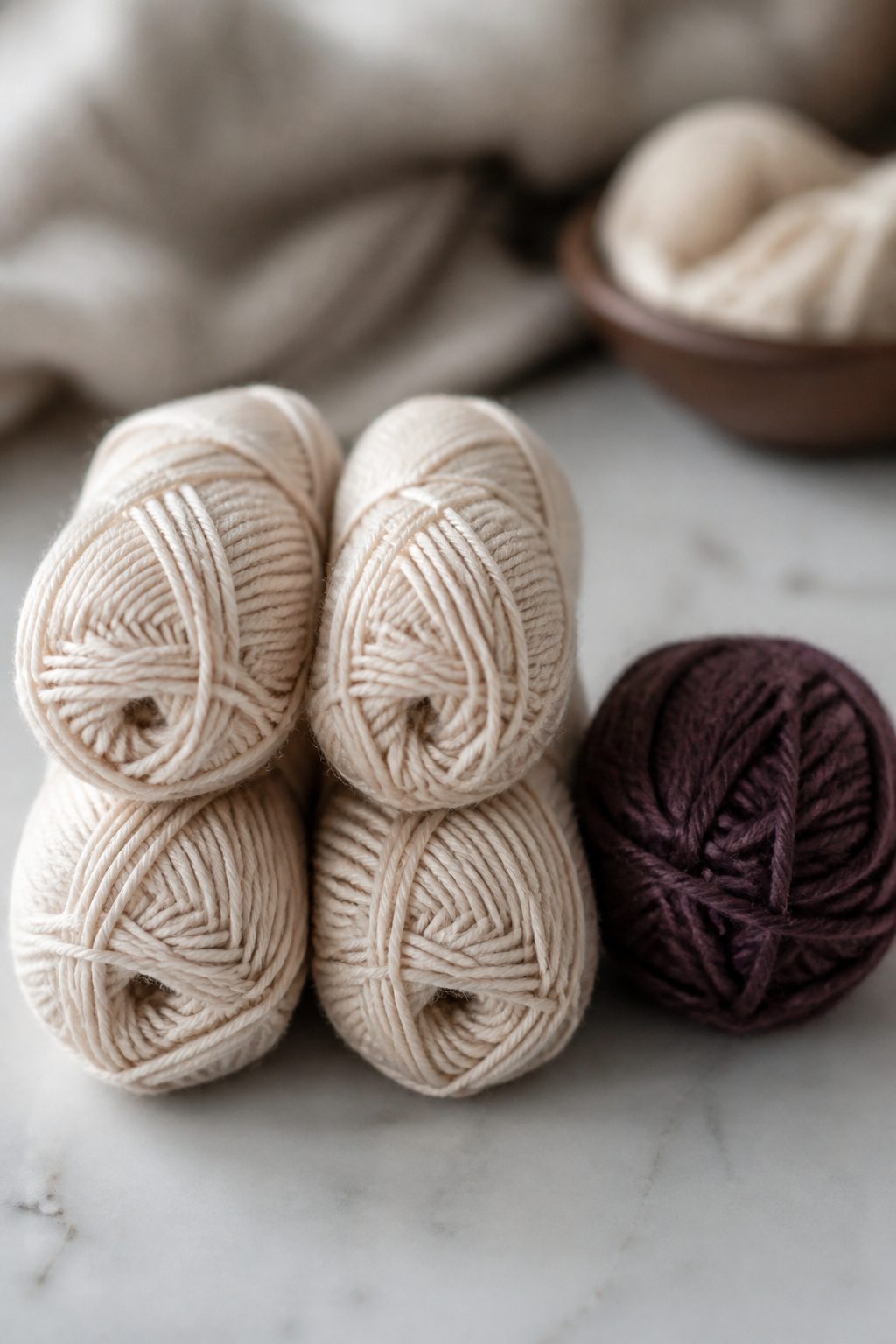
How a fleece becomes yarn
It starts on the animal. A shearer takes the whole fleece off in one piece, usually once a year for wool breeds. That fleece lands on a skirting table, which is a mesh surface, and the shepherd pulls off the belly wool, the tags, and any matted sections. What remains is the good fleece. A typical skirted fleece from a medium wool breed runs six to ten pounds. A fine wool breed might give four to eight. The weight drops again after washing.
Washing removes lanolin, also called grease, plus dirt and sweat. You can wash in a sink with hot water and a mild detergent, no agitation, or send the fleece to a scourer. A fleece can lose thirty to fifty percent of its weight in the wash. That number surprises people. Five pounds of greasy fleece may become two and a half to three and a half pounds of clean wool.
Drying takes a day or two on a screen in moving air. Then comes opening and carding. Hand cards or a drum carder separate the fibres and align them into a batt or a rolag. From there you draft the fibre, which means pulling it into a thinner line while adding twist. A drop spindle or a wheel does the twisting. The yarn is then wound off, washed again to set the twist, and dried. That is the whole path. Nothing in it is fast.
If you want to see the calendar side of local fibre work, the seasonal markets and community events listed at Brandon Heart are a reasonable place to start looking for a farm day or a guild table. The same page covers family activities and volunteer sign-ups, which matters if you want to learn skirting by hand rather than by video.
What changes between a local clip and a mill blend?
A local clip is one flock, one year, one breed or a known cross. A mill blend is a recipe. Mills buy wool from many sources, sort it by micron and colour, and blend it so that this year's yarn behaves like last year's. That consistency is the point. If you knit a sweater in a mill blend and run short, you can usually buy more of the same.
A local clip does not offer that. The yarn from one fleece is a limited run. Two fleeces from the same flock can differ in crimp, colour, and how they take dye. A fleece from a sheep that spent the summer on poor pasture will feel different from one off good grass. Weather, age of the animal, and how long the fleece grew all show up in the yarn.
There are practical trade-offs. Local clip yarn often has more variation in thickness, which shows in stockinette as a faint texture. Mill blends are more uniform, which makes them easier for colourwork and for smooth fabric. Local clip yarn may still carry a little vegetable matter, which is the hay and seed that skirting missed. You pick it out as you knit. Mill blends are usually cleaner.
On the other side, a local clip tells you where the wool came from. You can often meet the shepherd. You can ask what the sheep ate and how the fleece was stored. You can buy the same fleece next year if you liked it. That traceability is the reason many knitters keep a small stash of local yarn alongside their workhorse mill yarn.
What should a knitter ask about a breed and a clip?
Ask for the breed first. Breed tells you more about the finished fabric than almost anything else. Merino and Rambouillet are fine, soft, and good for next-to-skin wear, but they pill and felt easily. Corriedale and Romney sit in the middle, good for sweaters and hats. Lincoln, Leicester Longwool, and other longwools are strong and lustrous, good for outerwear and for socks that need to last. Down breeds like Suffolk and Hampshire are springy and hard-wearing, less soft against the neck.
Ask for staple length. Staple is the length of a single fibre. Under three inches is short and wants to be spun woollen, which gives a fuzzy, warm yarn. Over four inches is long and spins worsted, which gives a smooth, strong yarn with good stitch definition. If you plan to spin it yourself, staple length decides your draft.
Ask about grease and yield. A greasy fleece weighs more than the yarn you will get. Ask what the clean yield was, or what percentage of weight was lost in washing. If the seller does not know, that is useful information too.
Ask how it was skirted and stored. A well-skirted fleece has no tags, no dung, and no second cuts, which are short fibres from a second pass of the shears. Ask if it was stored in a cotton bag or a plastic bin. Wool needs to breathe. A fleece kept in a sealed bin in a warm shed can felt or grow mildew.
Ask about micron if the seller has it. Micron is the fibre diameter. Under 20 microns is soft enough for most people to wear against skin. 20 to 25 is fine for mid-layers. Over 30 is best for outerwear, bags, and rugs. A number is not a promise, but it narrows the field.
Ask what the yarn was washed with and how the twist was set. Some small producers use a no-rinse wash, which leaves a little residue. That is not a problem, but it can affect how the yarn takes a dye bath later.
Reading a clip like a knitter
Once you have a fleece or a skein in hand, do three things. First, pull a length and let it hang. See if it holds together or drifts apart. Second, rub it against your neck for a minute. That tells you more about softness than any number. Third, knit a swatch, wash it the way you plan to wash the finished piece, and let it dry flat. Measure the gauge before and after. Local yarn can change more in the wash than a superwash mill blend, and the change is usually shrinkage plus a little bloom.
Keep notes. Write the breed, the farm, the year, the weight, and the gauge on a card and keep it with the leftovers. If you buy from the same flock again, those notes are worth more than a colour card.
Where local wool fits in a working stash
A local clip is not a replacement for a mill blend. It is a different tool. Use the mill blend for the sweater you will knit twice and want to match. Use the local clip for the hat, the mitts, the small bag, the thing you make once and keep. Buy one skein first. Knit a swatch. Wash it. Then decide how much you need.
If you are new to buying fleece, start with a half fleece from a breed in the middle, Corriedale or Romney, and pay a spinner to process it into yarn the first time. Watch what comes back. That teaches you more about yield and prep than any article can. The second time, you will know what to ask.
Sources
For reference, see woolmark.com.