Entry of
Knitwear on a short shoot: continuity and spares
Practical notes on keeping knitted costume pieces consistent between takes, why a duplicate matters, and which stitches read best on camera.
Keep a knit consistent between takes by treating it as a costume with a fixed state: same piece, same way of putting it on, same blocking, and a written note of where every seam and fold sits. On a short shoot you rarely have a costume department, so the person holding the continuity photos is usually the same person holding the tape. Plan for that before the first setup, because a knit that shifts between takes is harder to fix in the edit than a moved chair.
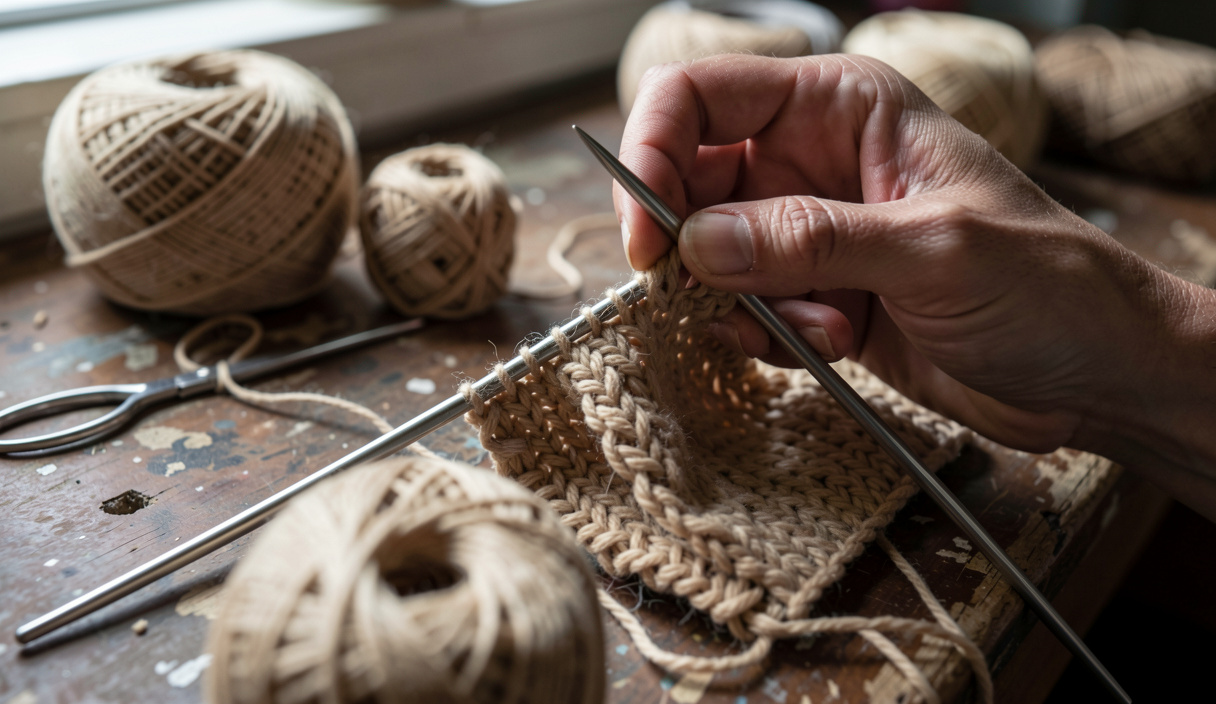
A duplicate matters because wool cannot be reset in ten minutes. If a sleeve catches on a door frame or a take ends with coffee on the cuff, a spare lets you keep the day moving. This is the same logic that runs through production planning on independent shorts, where weather and travel already eat the schedule: production planning for short films treats the day as a fixed budget of hours, and a spare knit is simply one more item that protects those hours.
How do you keep a knit consistent between takes?
Write down the state of the garment, not the mood of the scene. On a lined page, note which button is fastened, how far the cuff is turned back, whether the collar sits flat or folded, and which shoulder carries the bag strap. Photograph the actor from front, side and back at the end of the first good take. Those three frames are your reference for the rest of the day.
Dress the actor in the same order every time. A sweater pulled over the head lands differently than one stepped into, and a scarf tied once will not tie the same way twice. If the piece goes over the head, have the actor put it on the same way each reset, then adjust only the two or three points you noted.
Block the spare and the hero piece together, on the same day, with the same measurements. Two sweaters knitted from the same pattern but blocked on different afternoons can differ by two centimetres at the hem, and that difference shows when you cut between them.
Keep a small kit with the garment: a needle and matching yarn for a dropped stitch, a lint roller, a pair of sharp scissors, and a cloth bag. Store the knit folded, never on a hanger, because shoulders stretch and a stretched shoulder reads as a different garment on camera.
Mark the inside of the collar with a small stitch of contrasting thread on the spare only. When you are working fast in low light, that mark is the difference between the hero and the backup.
Why does a spare duplicate matter on set?
A spare is not a luxury. It is a scheduling tool. Wool absorbs sweat, holds dust, and picks up every surface it touches. On a short shoot with two or three locations in a day, the hero piece may not be cleanable before the next setup.
Three situations come up again and again. First, damage: a snag on a nail, a burn from a cigarette, a tear at the underarm. Second, soiling: mud, food, fake blood, rain. Third, fit drift: the actor loses or gains a little weight across a shoot that runs over several weekends, and the spare can be re-blocked slightly larger or smaller.
A spare also buys you a dry piece. If a scene calls for rain, the hero knit will be wet for hours. A second identical piece, kept in a bag with a dry cloth, lets you shoot the reverse angle the same afternoon.
Make the spare before the shoot, not during it. If you knit the duplicate in the same yarn and the same gauge, and you block both to the same measurements, the two pieces will cut together. If you are short on time, knit the spare in a slightly thicker yarn and treat it as a background piece only, worn by a person further from the lens.
Label both pieces. A strip of masking tape on the bag, with the scene numbers written in pencil, saves an argument at hour eleven.
Which stitches read best on camera?
Stockinette stitch is the safest choice for a lead actor. It is smooth, it takes light evenly, and it does not compete with the face. A plain stockinette sweater in a solid mid-tone reads as a sweater on camera, which is what you want when the audience should be looking at the eyes.
Ribbing reads well at cuffs, collars and hems because the vertical lines give the eye a place to rest and they hold their shape through repeated dressing. A 2x2 rib is more forgiving than 1x1 when the piece is pulled on and off.
Garter stitch is useful for texture in close shots. It catches light in small ridges and shows up well in black and white or in a low-contrast grade. It can look busy in a wide shot, so keep it to scarves, hats and small pieces.
Cables and colourwork are the hardest to keep consistent. A cable that crosses two rows early will be visible when you cut between takes, and a stranded pattern with long floats can pucker under a hard key light. If the story needs a patterned knit, choose a simple repeat and photograph it under the actual lighting before the shoot day.
Avoid very fine lace and very fuzzy yarns for anything that will be shot at a distance. Lace disappears into a mid-tone, and mohair halos bloom under a soft source, which can make the garment look like a blur. A smooth worsted or aran weight in a solid colour is easier to light and easier to match.
What should be in the continuity notes?
Keep the notes on one page per garment. At the top, write the scene numbers and the character name. Below that, list the fixed points: which way the collar sits, how many buttons are closed, the length of the turned cuff in centimetres, and the position of any pin or brooch.
Add a small sketch of the front and back, with arrows for the direction of any fold. Photographs are faster than words, but a sketch survives a bad phone battery.
Note the light. A knit that reads grey under a window may read brown under a tungsten lamp, and the continuity person needs to know which source was used for the reference frames. Write the source and the approximate distance.
Note the actor's own adjustments. If the actor always pushes the sleeves up to the elbow, write that down and let it happen. Fighting a habit costs more time than matching it.
How do you handle a knit that has to change on screen?
Sometimes the garment is meant to change: a character unravels a sleeve, or a sweater gets wet, or a piece is handed to another person. In that case, build the change into the plan rather than treating it as an accident.
Make three states of the same piece if the budget allows: clean, worn, and damaged. Shoot them in order, so you never have to restore a state you have already passed. Keep each state in its own bag with its own label.
If the change happens in one continuous take, rehearse the physical action with the actual garment. Wool does not slide the way cotton does, and a sleeve that will not pull free will cost you the take.
For a piece that is meant to look old, wash and dry the spare by hand before the shoot, then photograph it next to the hero under the same light. The difference between the two is your reference for the grade.
A short list for the day bag
Two identical knits, folded, in separate cloth bags. A needle and a length of matching yarn. A lint roller. Sharp scissors. A small towel. A printed page of continuity notes with the reference photographs taped to the back. A pencil, because ink runs when it rains.
None of this is complicated. It is the same habit as counting stitches before a seam: a few minutes of preparation that keeps the work from coming apart later.
Sources
For reference, see bfi.org.uk.