Entry of
Knitting aboard ship: ditty bag and watch projects
What a sailor's ditty bag held, what fits in a short watch, and which knitting projects survive a moving deck and a small bag.
A ditty bag is a small drawstring sack, usually canvas, that a sailor keeps for needles, thread, buttons, a palm, and a few personal tools. Aboard a minesweeper it also held knitting: one ball of yarn, four double-pointed needles, and a sock or a watch cap already on the needles. The project has to fit in the bag, work in fifteen-minute stretches, and survive a deck that moves under you.
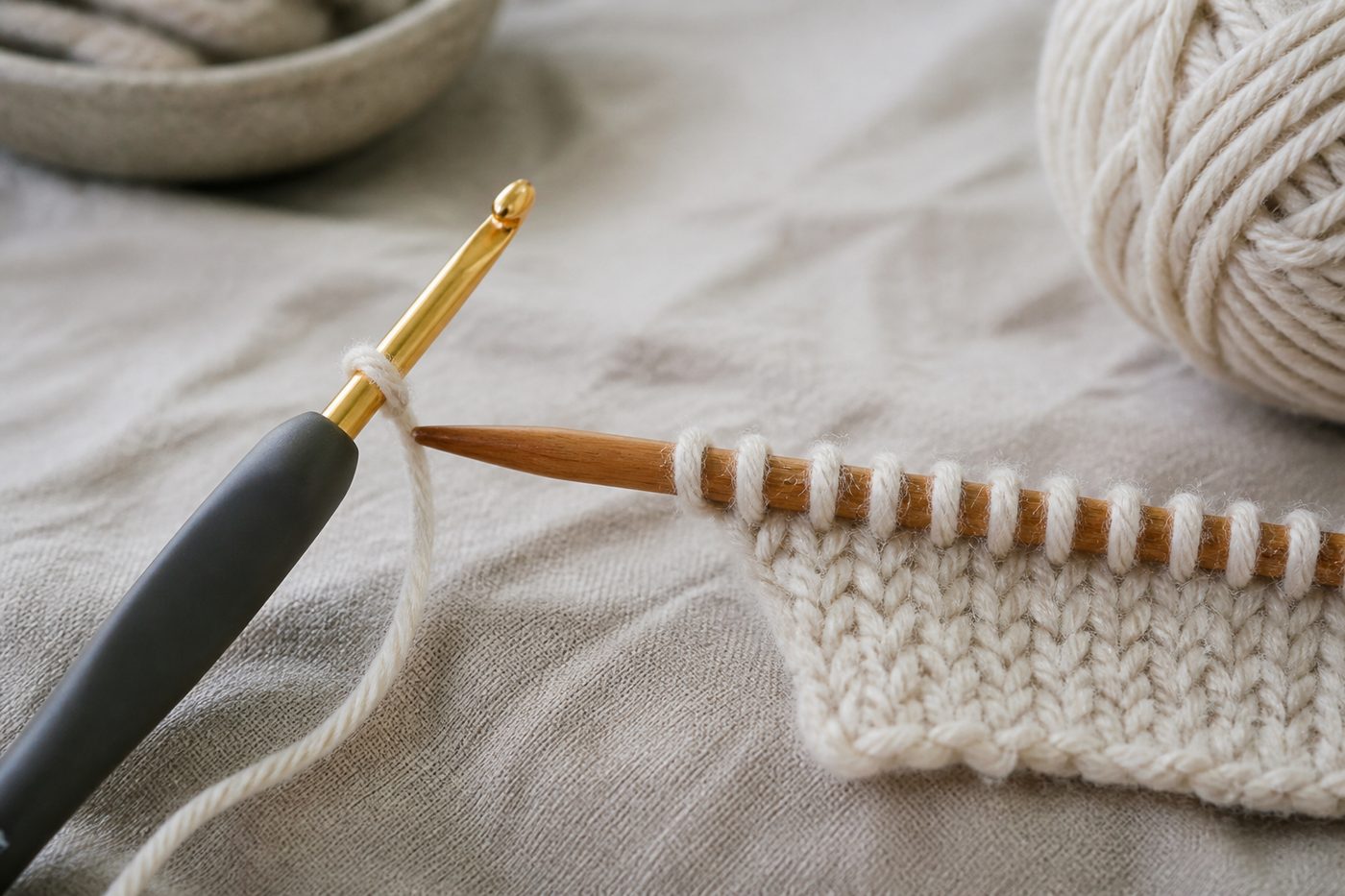
What did a sailor's ditty bag hold?
A working ditty bag for hand work runs about nine inches tall and six inches across when flat. That is the size that fits in a sea bag or hangs on a hook by a bunk. Inside, the usual contents are:
- One or two balls of yarn, wound tight, in a cloth sack so they do not roll.
- A set of four or five double-pointed needles, size 1 to 3 for socks, size 5 to 7 for caps, kept in a canvas sleeve.
- A small pair of scissors or a thread cutter.
- A darning needle, blunt, for grafting toes and weaving in ends.
- A tape measure, six feet, cloth.
- A few safety pins and a stitch holder made from a spare needle.
- A written gauge card, because a wet or cramped hand changes tension.
On a wooden-hulled minesweeper the bag also carried a scrap of chamois and a small tin of oil, because the same hands that knit also work wire and rope. The yarn stays in the sack until you cast on. Salt air and coal dust do not improve wool.
If you want to know how a real sweep crew kept its records and its gear, the deck logs and muster rolls of the USS Phoebe are a good place to see what a small ship actually carried and how the watch day was divided. The minesweeper deck logs show the pattern of watches, ports, and long stretches at sea that shaped what a sailor could carry and when he could sit down with it.
What can be knitted in short watches?
A watch on a small ship is four hours on, four off, or a shorter turn at general quarters. The useful knitting is anything you can put down mid-row without losing your place. That rules out lace with a chart and rules in plain stockinette in the round.
Good candidates:
- Socks, cuff down, on four needles. A plain 64-stitch sock at 8 stitches per inch gives about one inch of leg per twenty minutes once you know the pattern. A full pair takes a week of watches, not a day.
- Watch caps. A 96-stitch cap in worsted on size 6 needles works up in two or three watches. Ribbing for two inches, then plain round to the crown.
- Fingerless mitts. Small, fast, and useful on a cold bridge or in a radio room.
- A scarf knit lengthwise in garter stitch. It never needs a row counter. You stop when the ball runs out.
- Washcloths in cotton. Cheap, quick, and easy to give away at a port call.
Avoid anything with a long chart, a provisional cast-on, or a steek. A moving deck and a dim compartment are not the place for a complicated row.
Which projects suit a moving deck and a small bag?
The test is simple. Can you knit it with your elbows close to your body, in the dark, with one eye on a gauge or a horizon? If not, leave it ashore.
A sock on four needles passes the test. The work sits in your lap, the needles are short, and the ball stays in the bag. A sweater in pieces does not. A sweater knit flat needs a lap full of fabric, a pattern on a table, and a place to lay the pieces out. On a sweep deck there is no table.
Small round projects also survive interruption. If the general alarm sounds, you push the needles into the ball, drop the whole thing in the bag, and stow it. Nothing unravels if you push the needles through the fabric and pull the working yarn snug. A flat piece on a long circular needle will slide off the moment you stand up.
Weight matters too. A 100-gram ball of sock yarn and four needles weighs about four ounces. A sweater's worth of yarn weighs two pounds or more, and that is two pounds you carry up and down a ladder. Keep the bag light.
How do you keep yarn and needles dry at sea?
Wool holds moisture and salt. A canvas ditty bag is not waterproof. Two habits help.
First, keep the working ball in a small stuff sack inside the ditty bag, and keep the ditty bag inside the sea bag when you are not knitting. Second, dry the project flat when you can, not hanging on a line in the wind where it will stretch.
Needles rust. Carbon steel needles will pit in a week of damp air. Bamboo and nickel-plated needles hold up better. Wipe them with the same oiled rag you keep for tools, then wipe them dry. Do not oil the yarn.
If the yarn gets wet with salt water, rinse it in fresh water when you reach a tap, roll it in a towel, and lay it flat. Do not wring it. Salt left in wool will draw damp for months.
What does a watch schedule do to a knitting project?
A four-on, four-off schedule gives you four hours off, but not four hours of free time. You eat, sleep, stand a second duty, and write letters in that block. Real knitting time is fifteen to forty minutes, often in low light.
That shapes the project more than anything else. You want a pattern you can read once and remember. You want a stitch count that stays the same for many rounds. You want a place to stop that is obvious to the hand, like the end of a needle or the start of a heel.
A sock is built for this. The leg is plain round. The heel has a clear beginning and end. The foot is plain again. You can knit a round, put it down, and pick it up an hour later without checking a chart.
A cap is nearly as good. Ribbing for two inches, then plain round to the crown. The only counting is at the decreases, and those take ten minutes.
A scarf in garter stitch is the easiest of all. Every row is knit. You can do it in the dark. It is also the least interesting, which matters on a long deployment.
What should go in the bag for a first deployment?
Keep it to one project and one spare. A first deployment is not the time for a yarn stash.
- One pair of socks on the needles, with the pattern written on an index card.
- One extra ball of the same yarn, in case of a bad knot or a lost ball.
- One spare set of needles in the same size, because needles bend and drop.
- A darning needle, a tape measure, and a small pair of scissors.
- A cloth sack for the yarn, and a second sack for the finished work.
That is a ditty bag that weighs under a pound and fits in a corner of a sea bag. It will keep your hands busy in the quiet hours and give you something to send home from a port call.
For the historical side, the deck logs and muster rolls of a small minesweeper are the record of how those hours were actually spent. The watch bill, the ports, and the long patrols are all in the paperwork. A knitter reading them will recognize the rhythm: short turns, small tools, and a project that fits in the hand.
Sources
For reference, see history.navy.mil.