Entry of
Wartime knitting appeals: socks and balaclavas
What First World War knitting appeals asked for: socks, balaclavas, mittens, yarn weight, needle sizes, tension, and how parcels reached the front.
Wartime knitting appeals asked mainly for socks, balaclavas, mittens, and body belts. Socks came first, in the largest numbers, because wet feet caused more casualties than enemy fire in the trenches. Balaclavas came second, then mittens and wristlets for men standing sentry in the cold.
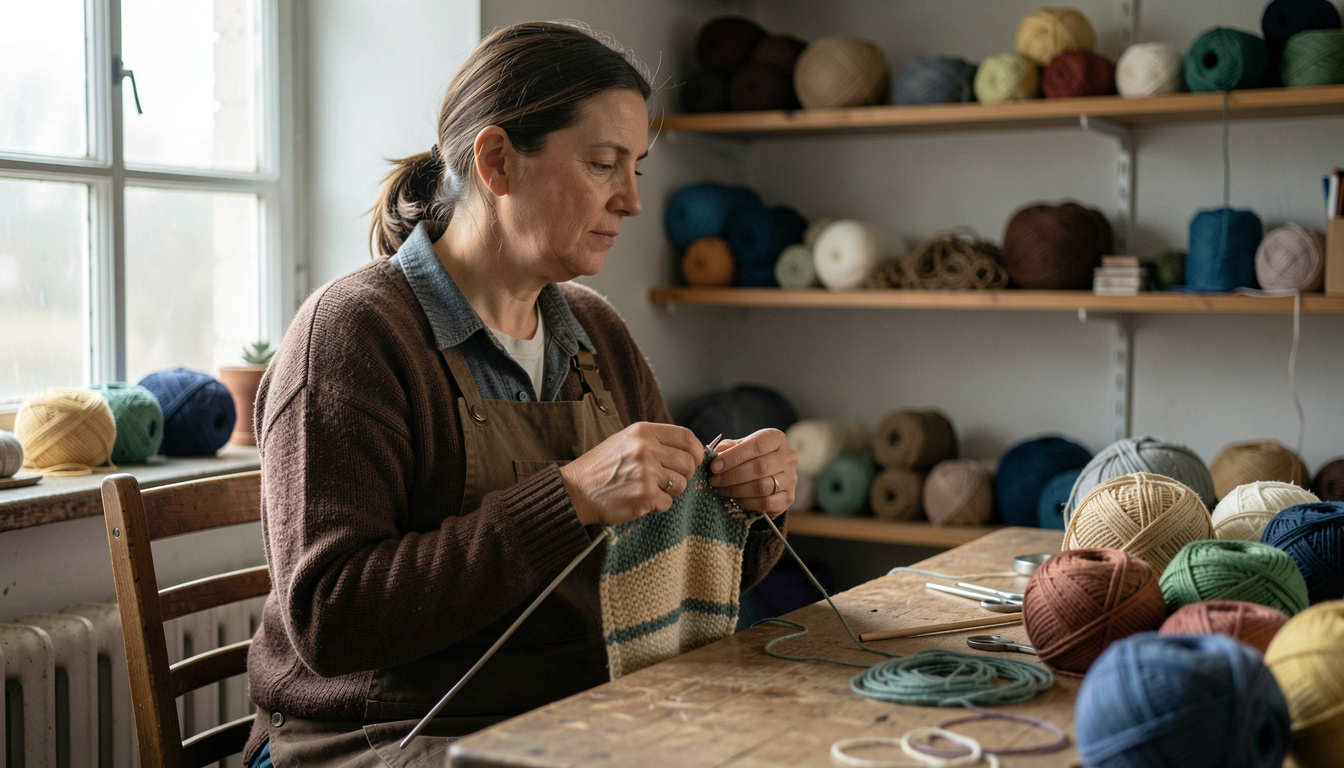
Which knitted items did wartime appeals request?
The lists were short and repeated. Socks, always socks. Balaclavas, sometimes called helmets or cap comforters. Mittens with a trigger finger, or plain mittens with a separate thumb. Body belts, wide ribbed bands worn around the waist under the tunic. Some appeals added wristlets, chest protectors, and mufflers, though scarves were often refused because they caught on equipment.
Socks were the priority because trench feet put men in hospital. A soldier might wear out two or three pairs a week in wet conditions. Multiply that by a battalion and the demand never stopped. Appeals ran through newspapers, churches, schools, and women's institutes, and the same four or five items appeared on every printed list.
Balaclavas were knitted to cover the neck and ears, leaving the face open. They were worn under the helmet, which was steel and cold against the skin. Mittens were made with a gap for the trigger finger, or as a pair of plain mittens plus a separate fingerless glove. Body belts were ribbed to stay close to the body and were said to help against the damp.
The knitting was not decorative. Nothing was made for looks. Every item had to be plain, strong, and washable. If you want to see how one town recorded the men who wore these things, the local memorial records at Tadcaster war memorials show how names, regiments, and dates were gathered after the war. That work of listing and checking is the same kind of careful record keeping that knitting appeals depended on.
What yarn, needle sizes and tension were recommended?
Most appeals specified fingering weight wool, sometimes called 4-ply, in a natural or grey shade. The yarn had to be pure wool, not cotton, not silk, not a blend. Wool held warmth when wet and could be washed without losing shape. Colours were plain: grey, khaki, navy, natural. Bright colours were refused because they showed through the uniform or drew attention in the line.
Needle sizes were given in the old British numbering. For socks, the usual range was size 14 to size 16, which is fine. For balaclavas, size 9 to size 11. For mittens, size 10 to size 12. These are small needles. The point was a dense fabric, not a loose one.
Tension was stated as a measurement, not a feeling. A common instruction was 8 to 9 stitches to the inch in stocking stitch for socks, and 6 to 7 stitches to the inch for balaclavas. If your knitting came out looser, you went down a needle size. If it came out tighter, you went up. The appeals printed these numbers because a sock that was too loose wore through at the heel in days.
Heels were reinforced. Many patterns used a double thread at the heel, or a thicker yarn held together with the main yarn. Toes were grafted, not sewn, so there was no ridge to rub. Cuffs were ribbed, usually two by two, to grip the calf without cutting off circulation. Balaclavas were knitted in rib or in a dense moss stitch, with a shaped opening for the face and a short flap at the back of the neck.
Yarn was sometimes supplied by the appeal committee, sometimes bought by the knitter. When it was supplied, it came in one-ounce or two-ounce balls, with a fixed number of balls per garment. A pair of socks took about four ounces. A balaclava took about six. A body belt took about eight. These figures were printed so that committees could estimate how much wool to order.
How were finished items collected and sent?
Collection was local and regular. A depot, a church hall, a school, or a shop window served as a drop-off point. Volunteers checked each item against a list: correct size, correct yarn, no knots, no loose ends, no fancy stitches. Items that failed were returned or kept for civilian use. Items that passed were sorted into bundles by type and size.
Bundles went to a central depot, often in a city, where they were packed into bales or boxes. Each parcel was labelled with the unit or the hospital it was meant for. Some parcels went to a named regiment. Others went to a general pool and were handed out where the need was greatest. Shipping was by rail to a port, then by boat, then by rail again or by lorry to the front.
The time from knitting to wearing could be weeks or months. That is why appeals asked for standard sizes and standard yarn. A parcel of odd socks was harder to distribute than a parcel of matched pairs. Committees kept records of what was sent, to whom, and when. Those records are one of the reasons local historians can still trace what a town contributed.
Knitters also wrote notes and put them in the parcels. Some included their name and address. Soldiers wrote back, and those letters are now in archives. They mention fit, warmth, and how long a pair lasted. Some mention that the socks were the only dry thing they had. Those letters are practical evidence of what the appeals actually achieved.
Did the knitting stop when the war ended?
No. Appeals continued into 1919 and 1920, for men still in hospital, for men waiting to be demobilised, and for prisoners of war returning home. Some committees kept going for a year or two after the armistice, then closed. The patterns and the size lists were kept, and some were reused in the Second World War.
The end of the appeals left a paper trail: minute books, account books, lists of donors, lists of items sent. That paper trail is what local history groups work from now. It is the same kind of material that family historians use when they trace a soldier's service, his wounds, his transfer to a labour unit, or his pension. The knitting appeal records and the service records sit in the same archives, often in the same box.
What can a modern knitter take from these patterns?
The old patterns are still usable. A plain sock in fingering weight, knitted at 8 stitches to the inch on size 15 needles, is a good sock today. A ribbed balaclava in worsted weight on size 9 needles is a warm winter hat. A body belt is a ribbed tube, and it works as a kidney warmer for anyone who works outdoors.
The main difference is the yarn. Wartime wool was often coarser and less uniform than modern yarn. If you use a smooth modern wool, go down a needle size to get the same density. If you use a soft wool, expect it to wear faster at the heel. Reinforce the heel with a nylon thread or a second strand, as the old patterns did.
Tension matters more than the pattern. Knit a swatch, measure it, and change needles until you match the gauge. That was the rule in 1916 and it is the rule now. The appeals did not ask for beautiful knitting. They asked for knitting that would last.
If you want to knit for a modern appeal, the same principles apply: ask what is needed, use the yarn specified, match the gauge, and send the items where they are asked for. The rest is the same as it was: wool, needles, and time.
Sources
For reference, see iwm.org.uk.