Entry of
Pattern leaflets, booklets and books on a knitter's shelf
What a pattern leaflet holds that a book does not, how a booklet stays open on the table, and what belongs on a knitter's reference shelf.
A pattern leaflet holds one design, one gauge and one size range, printed on a single folded sheet. A book holds many designs plus chapters on technique, and you cannot lay it flat without breaking the spine. The shelf needs both, and it needs them sorted by how you actually use them.
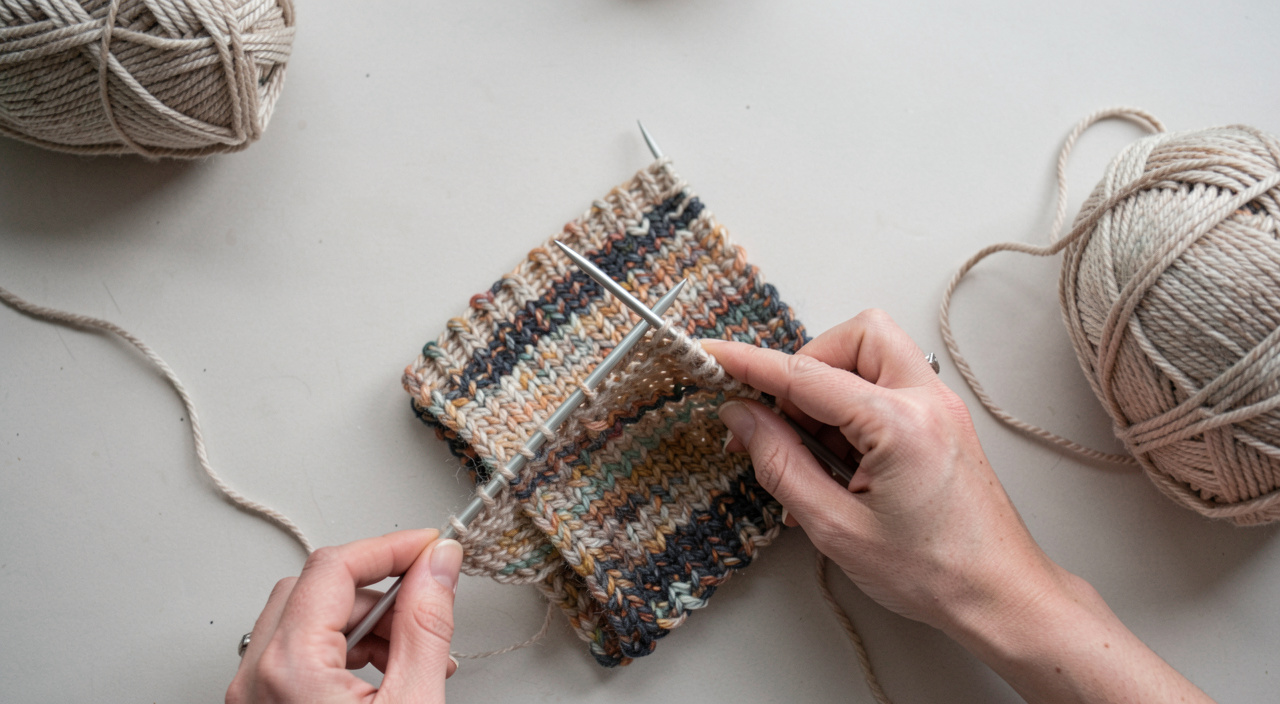
What does a pattern leaflet hold that a book does not?
A leaflet is a single pattern, sold alone. It carries the gauge, the needle size, the yarn weight and the finished measurements for one garment or one accessory. Nothing else. That narrowness is the point.
When you knit from a leaflet you have the whole pattern in front of you at once. No flipping to a chart forty pages away. No hunting for the abbreviation key in the back. The numbers you need sit on one spread, usually four panels: cover photo, materials, instructions, chart.
Leaflets also record yarns that books leave out. A booklet from a yarn company exists to sell that yarn, so it names the exact base, the exact colorway and the exact yardage. Ten years later that base may be discontinued, but the gauge and the fibre content are still there. You can substitute from that.
A book, by contrast, is written to outlive its yarns. It gives you a gauge and a stitch count and trusts you to find a yarn that meets it. That is a different kind of help.
One more thing a leaflet does: it dates itself. The photo styling, the paper stock, the price printed on the corner. A stack of leaflets is a rough timeline of what knitters were making in a given decade. Books get revised and reprinted. Leaflets just sit there in their original form.
If you want to understand how small print runs work, how a booklet gets an ISBN and how a publisher decides between a stapled sheet and a bound volume, there is a useful Italian notebook on the trade at booklet and book formats. It covers the same decisions from the publishing side: format, print run, distribution.
How does a booklet stay open on the table?
A stapled booklet, the kind with two or three wire stitches on the spine, will lie flat if you break it in first. Open it to the center, press the whole spine down on a table, then press the front and back covers back. Do this once and the booklet stops fighting you.
A perfect-bound booklet, with a glued square spine, will not lie flat. It wants to close. Two solutions work.
- Photocopy the pages you are working from and clip them to a board. The original stays clean.
- Slide the booklet into a document stand or a music stand at a shallow angle. Gravity holds the pages down.
A hardcover book needs a different treatment. If the spine is sewn and the binding is not too tight, you can open it to the middle, set it spine-down on the table and let the two halves fall open. That is how you read a chart without weights. If the book resists, do not force it. Copy the chart instead.
For charts, a magnetic board or a strip of highlighter tape across the row does more for your accuracy than any binding trick. Mark the row you are on. Move the tape up.
A note on paper weight. Leaflets printed on thin coated stock curl at the corners and slide off the table. Heavier uncoated paper stays put. If you are choosing between two editions of the same pattern, take the heavier paper.
What belongs on a knitter's reference shelf?
Sort by function, not by publisher. Four groups cover almost everything.
Gauge and fit. One good book on sweater construction with a section on ease and body measurements. You will use the measurement tables more than the patterns.
Stitch dictionaries. One comprehensive dictionary is enough. A second one is only worth the shelf space if it covers a tradition the first one skips, such as Estonian or Shetland lace.
Single patterns. Leaflets, booklets, downloaded PDFs printed and stapled. Keep them in a ring binder by category: hats, mittens, baby, socks. A binder with plastic sleeves protects the paper and lets you pull one sheet out without losing the rest.
Reference for the boring parts. Kitchener stitch, short rows, picking up a neckline, seaming. One thin booklet or a laminated card does this job. You do not need a chapter.
Then there is the question of what to keep. A pattern you have knit twice and would knit again stays. A pattern you bought for one yarn that no longer exists can go, unless the construction taught you something. Be honest about which is which. Shelf space in a small house is finite, and a shelf you cannot find anything on is worse than a short shelf.
Do you need the book if you have the leaflet?
Sometimes yes. A leaflet gives you one size range and one yarn. A book gives you the reasoning behind the numbers, which matters when you need to alter the pattern.
Say the leaflet is written for a 38-inch chest and you need a 44. The leaflet may give you one larger size, or none. A construction book tells you where to add width: at the side seams, at the yoke, at the raglan line. It tells you how that changes the armhole depth. That is the part a leaflet leaves out.
The reverse is also true. A book pattern written for a specific yarn weight may not match the yarn you have. A leaflet from a yarn company is often more precise about the exact base it was designed for.
Practical rule: buy the leaflet for the design, buy the book for the method. If a design exists only in a book, and you plan to alter it, copy the instructions and write your changes in the margin of the copy. Keep the book clean.
How do you store and label a growing collection?
Label everything at the moment you file it. Write the yarn weight, the gauge and the needle size on a small sticker on the corner of the leaflet or the binder page. In two years you will not remember, and the cover photo will not tell you.
For downloaded patterns, print them. A PDF on a phone is fine for reading and bad for knitting. Print single-sided, three-hole punch, file by category. If a pattern runs long, print the chart pages separately and keep them in a sleeve at the front of the binder.
Keep a single index card or a note on your phone listing what you own by category. When you are standing in a shop holding a booklet, you can check whether you already have three hat patterns in that gauge.
Store vertically, not stacked. A stack of leaflets compresses at the bottom and the staples rust against the paper. A magazine file or a shallow box, spine up, keeps them dry and findable.
Finally, keep a small working pile apart from the archive. Three or four patterns you are actively knitting from, in a tray or a tote, near the chair. The rest of the shelf is storage. The working pile is the shelf doing its job.
Sources
For reference, see loc.gov.