Entry of
Knitted Work on a Gallery Wall: Texture, Scale, Repetition
How knitted pieces read at wall scale, what repetition does to a single stitch, and how to look at textile work in a gallery without rushing.
A knitted piece on a gallery wall reads first as texture, then as scale, then as time. From three feet away you see the surface: the halo of fibre, the shadow in each stitch, the slight sag of a hanging edge. From ten feet away you see the shape the maker built, and the number of hours it took becomes a physical fact you can measure with your eye.
How does a knitted piece read at wall scale?
At wall scale, knitting stops being a garment and becomes a plane. A sweater on a body curves. The same fabric stretched flat on a wall shows every decision: gauge, tension, the places where the maker changed needles, the places where the yarn ran out and a new dye lot began.
Stand close enough to see individual stitches and you are reading the surface. Stand back and you are reading the structure. Both readings are correct. Neither one is complete.
Scale changes what the eye does first. A small swatch pinned to a wall asks to be inspected. A piece two metres wide asks to be walked past. The maker knows this. If you see a large knitted work, look at the edges first. A cast-on edge is usually firmer than a bind-off edge, and on a wall that difference becomes a line. Look at the bottom hem. If it sags, the piece was hung by its top edge only. If it holds straight, there is a rod, a batten, or a stitched sleeve behind it.
Weight matters here. Wool is heavy. A dense fabric one metre wide can pull several kilos against its own mounting. That weight shows up as a slight bow along the top, or as a shadow that is wider at the centre than at the corners. This is not a flaw. It is information about the material.
If you want a vocabulary for this kind of looking, the writing on contemporary art practice treats surface, weight and patina as readable evidence rather than decoration. That approach transfers directly to textile. A knitted plane has a patina too, even when it is new: the faint sheen where light hits the raised stitches, the duller valleys between them.
What changes when one stitch is repeated many times?
One knit stitch is a small loop pulled through another loop. Nothing more. Repeat it two hundred times across a row and something else appears: a rhythm, a direction, a grain.
Repetition does three things at wall scale.
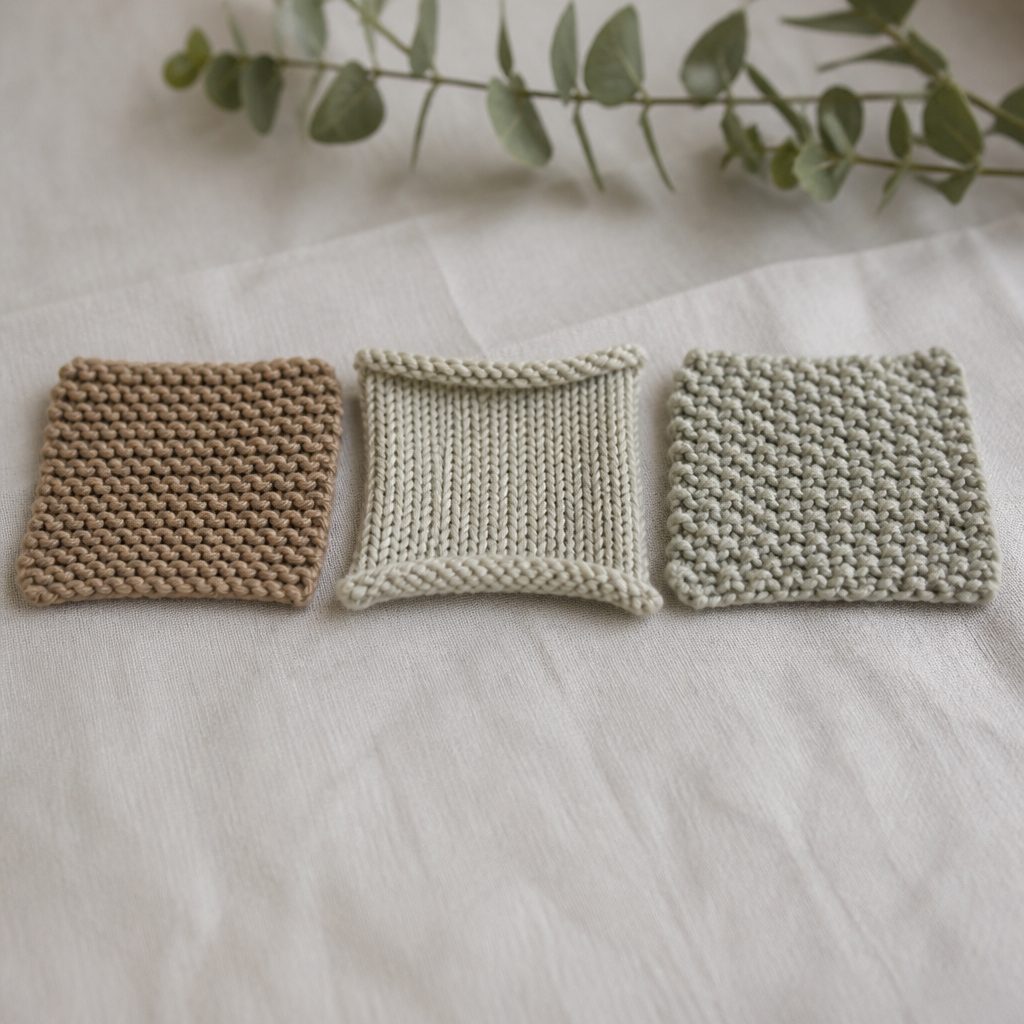
First, it creates a direction. Stockinette has vertical columns. Garter has horizontal ridges. Ribbing has both. On a wall, these directions fight or agree with the architecture around them. A piece of vertical stockinette hung between two vertical door frames will look calm. The same piece hung under a horizontal beam will look tense. That is not a metaphor. It is how the eye reads line against line.
Second, repetition hides the individual stitch and reveals the pattern. At a distance of two metres, a single stitch in worsted weight is roughly four to five millimetres wide. You cannot count them. You see the field they make. This is the same effect as a painted surface made of many small marks: the mark disappears, the field remains.
Third, repetition shows error. In a field of identical stitches, one stitch worked at a different tension is visible from across the room. A dropped stitch, a yarn-over, a change of needle size: each one becomes a small event. Some makers leave these in. Some pick them up and correct them. Either way, the repetition is what makes them legible.
This is why so much textile work in galleries uses a single stitch repeated across a large area. It is not laziness. It is a way of making time visible. Every row is a unit of time. Two hundred rows is two hundred units. The viewer does not need to count. The body understands the accumulation.
How should a visitor look at textile work in a gallery?
Slowly, and in three passes.
First pass: from the doorway. Do not walk up. Look at the whole wall. Note the shape of the piece, its proportion to the wall, and where the light falls on it. Textile is unusually sensitive to raking light. A piece hung near a window will change through the day. A piece under a spotlight will show every raised stitch as a small bright dot.
Second pass: at arm's length, but not touching. Look at the edges. Look at the corners. Look at the back if it is visible. A knitted work tells you how it was made at its edges: whether it was cast on and bound off, whether it was cut, whether it was seamed. Look at the yarn itself. Is it plied or single? Is it smooth or hairy? A hairy yarn blurs the stitch definition. A smooth yarn sharpens it. This changes how the repetition reads.
Third pass: step back again. Now look at the piece as a whole with everything you have learned. The texture you saw up close and the shape you saw from the door should now be one thing.
A few practical notes. Do not touch the work. Oils from hands mark fibre, and a gallery is not a yarn shop where skeins are handled. Keep bags and coats clear of the wall. If the piece is hung low, watch your step. If there is a bench, sit on it and look for five minutes. Textile rewards duration more than most media. The first minute gives you the surface. The fifth minute gives you the structure.
Reading repetition against the room
A gallery is not a neutral box. It has a rhythm of its own: the pace of the rooms, the height of the hang, the distance between works.
A knitted piece placed in a room with paintings will read differently than the same piece in a room with sculpture. Paintings give the eye a flat plane to compare against. Sculpture gives the eye volume. Knitted fabric sits between the two: it is flat like a painting but it has depth like an object. It casts a small shadow. It moves slightly with air currents.
If you are looking at a group show, notice where the textile work sits in the sequence. If it comes after three dense, dark paintings, it will feel light. If it comes after a bare wall, it will feel heavy. This is not accidental. Curators place work by weight, colour and pace, the same way a knitter places stripes.
Repetition in the room matters too. If two works in the same show use the same repeated unit, the eye will link them. If a knitted piece repeats a shape that appears elsewhere as a printed mark or a cast form, that is a conversation. You do not need a catalogue to see it. You need to walk the rooms twice.
What to carry away
You do not need to know how to knit to read a knitted work on a wall. You need to know three things: that texture is surface, that scale is structure, and that repetition is time.
Look at the surface from close. Look at the structure from far. Look at the time by counting nothing and letting the rows accumulate in your eye. Then leave the room and come back. The piece will look different the second time. That difference is the work doing what it was made to do.
Sources
For reference, see tate.org.uk.