Entry of
Warm hand knits for cold-weather horn players
What brass and hunting horn players wear on cold mornings: yarns, stitches and sizing for wrist warmers and fingerless mitts that fit under an instrument.
On a cold morning outdoors, a horn player wears thin layers and keeps the hands as free as possible: a wool wrist warmer or a fingerless mitt in a tight gauge, with the fingers and the thumb tip open. Cover the forearm and the back of the hand, leave the palm and the fingertips bare, and the valves or the finger holes stay reachable. Anything thicker than about 3 mm at the palm will change how the hand sits on the instrument.
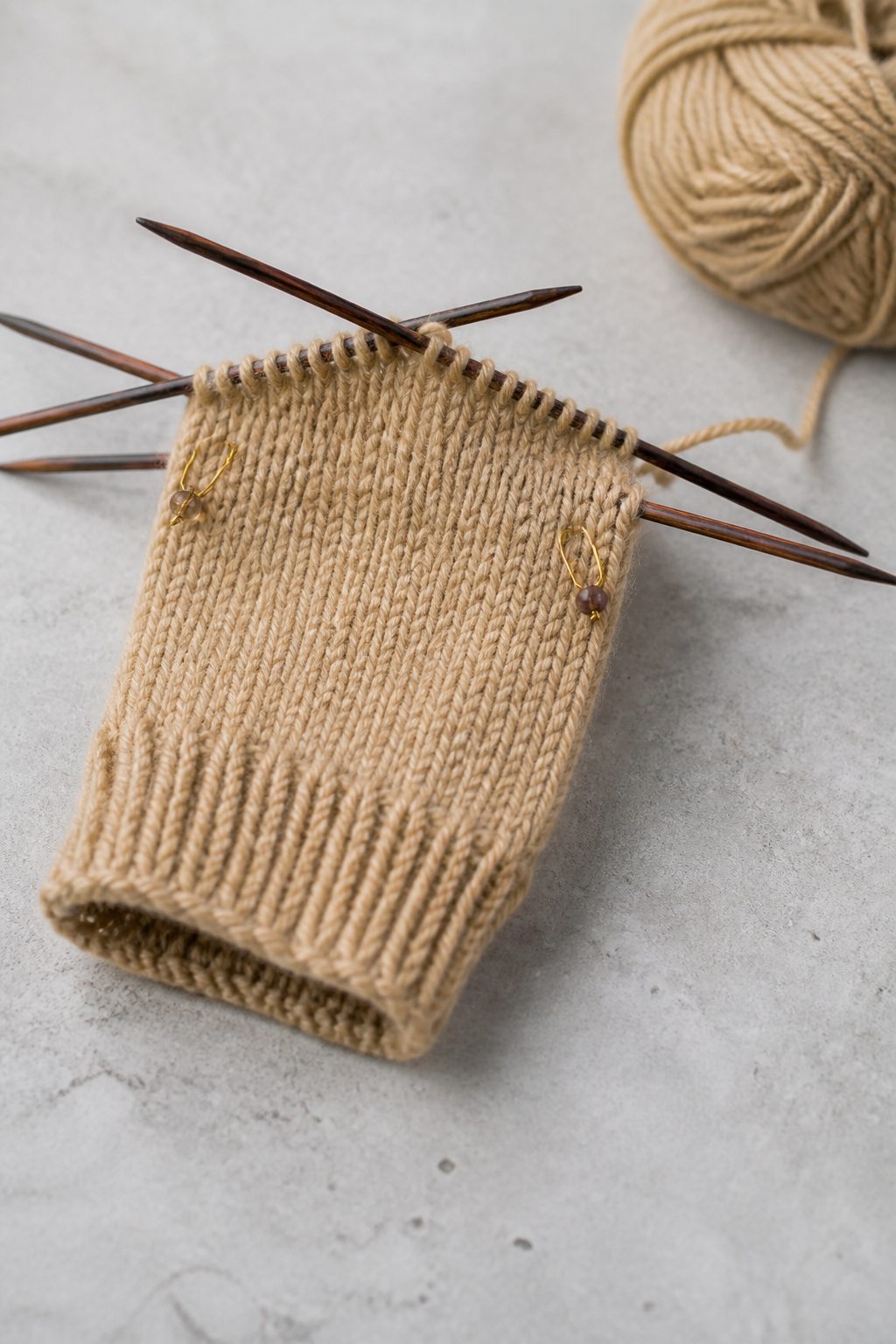
The players who write about this in German, on the horn and brass tradition pages, describe the same problem: a Fürst-Pless or a Parforcehorn is held with the right hand inside the bell, and that hand cannot be wrapped in anything bulky. The left hand holds the instrument and works the valves or the holes. So the knitting goes on the left wrist and forearm, and on the right hand only as far as the knuckles.
What do players of brass and hunting horns wear on cold mornings outdoors?
A base layer on the torso, a thin glove liner, and a knitted wrist warmer or fingerless mitt over it. That is the usual arrangement. The liner is often silk or a thin merino, 150 to 180 m per 50 g, knit at 30 stitches to 10 cm. The knitted piece goes on top at 26 to 28 stitches to 10 cm.
For a hunting horn played outdoors in November, the hand inside the bell is the cold one. A wrist warmer that stops at the knuckles is enough there. For a trumpet or a flugelhorn, both hands work valves, so both wrists get a warmer and the fingers stay bare from the first knuckle.
A word on the rest of the body. A hat and a scarf matter more than people expect, because a cold neck makes the shoulders rise and the embouchure tightens. A thin cowl in the same yarn as the wrist warmers, 20 cm deep, worn under the jacket collar, is a practical piece.
Which yarns and stitches keep fingers free enough to work the valves?
Yarn first. Use a smooth, tightly spun wool or a wool and alpaca blend, 200 to 250 m per 50 g, knit on 2.5 mm to 3 mm needles. Smooth matters: a halo of loose fibres catches on valve caps and on the keywork. Tight spin also means less pilling where the hand rubs the instrument.
Avoid cotton. It has no loft, it goes cold and damp against the skin, and it stretches out at the wrist. Avoid superwash merino if the player's hands sweat inside the bell, because the fibre slides and the cuff loses its grip. A plain non-superwash wool at 400 m per 100 g is the workhorse here.
Stitches second. Ribbing is the whole answer for the cuff. A 2 by 2 rib, or a 1 by 1 rib on a smaller needle, pulls in and stays put without elastic. For the back of the hand, a plain stockinette panel is fine, but a small cable or a broken rib gives a little more thickness over the tendons without adding bulk at the palm.
Keep the palm side plain and thin. That is the rule. If you want texture, put it on the back of the hand only.
Gauge notes from the shop: a wrist warmer in 2 by 2 rib at 28 stitches to 10 cm, knit flat and seamed, uses about 25 g of yarn for a 20 cm cuff. A fingerless mitt with a thumb gusset uses 35 to 40 g. Two pairs from one 100 g skein, with a little left over.
How do you size a wrist warmer or a fingerless mitt so it sits under an instrument?
Measure the hand, not the wrist alone. Three numbers matter:
- Circumference around the knuckles, thumb included, in cm.
- Length from the wrist crease to the first knuckle.
- Length from the wrist crease to the middle of the forearm, where the cuff should end.
A wrist warmer should be 1 to 2 cm smaller than the knuckle circumference, because ribbing opens when worn. A fingerless mitt should be 0 to 1 cm smaller, no more, or the thumb gusset will pull.
For the length: the cuff ends 8 to 10 cm up the forearm for a hunting horn player, because the sleeve of a jacket rides there. For a trumpet player, 5 to 7 cm is enough.
The opening for the fingers: bind off the top 3 to 4 cm of the mitt and leave the rest. Do not add a rolled edge, it catches on the valve casing. A single crochet chain along the opening, worked in the same yarn, gives a firm edge that will not curl.
The thumb. A gusset is better than a slit. Work increases every third round, 6 to 8 times, then put the gusset stitches on waste yarn and cast on 2 stitches over the gap. The thumb sits free from the first joint. For a hunting horn player who holds the bell with the right hand, the right mitt can skip the gusset entirely and be a plain tube.
A note on the left hand and the right hand
They are not the same job. On a Fürst-Pless horn, the right hand goes into the bell and stays there. It needs warmth, not dexterity. A tube of 2 by 2 rib, 12 cm long, no thumb, is the right piece. On a trumpet or a tenor horn, both hands are on the valves, so both pieces need a thumb gusset and a short cuff.
If you are knitting for someone else, ask which instrument and which hand. It changes the pattern. A pair of matching mitts is often the wrong answer.
Care, and what happens after a wet morning
Wool wrist warmers get damp from breath and from the inside of a bell. Let them dry flat, away from a radiator, and they will last several seasons. Wash by hand in cool water with a little wool soap, squeeze, do not wring, and dry flat. A pair knit at 28 stitches to 10 cm will felt if it goes through a hot machine cycle, and a felted wrist warmer no longer fits under a valve.
Knit two pairs. One stays in the instrument case, one stays at home. On a cold morning, the pair in the case is the one that gets used.
Sizing table for a quick reference
- Wrist circumference 16 cm: cast on 44 stitches in 2 by 2 rib at 28 stitches to 10 cm.
- Wrist circumference 18 cm: cast on 48 stitches.
- Wrist circumference 20 cm: cast on 52 stitches.
- Cuff length for a hunting horn: 8 to 10 cm.
- Cuff length for a trumpet: 5 to 7 cm.
- Yarn per pair: 50 to 80 g.
These numbers are a starting point. Knit a swatch, measure it after washing, and adjust. A wrist warmer is a small project, two evenings at most, and it is worth knitting the first one plain before you add a cable.
Sources
For reference, see britannica.com.