Entry of
A knitting project that travels between two houses
A work in progress survives a two-house week when it is small, self-contained and written down. What to pack, what to duplicate, and how a child's knitting stays alive in both homes.
A knitting project can travel between two houses for years, provided it is chosen for the journey: small, self-contained and written down so that either household can pick it up without a phone call. The bag matters less than the notes inside it. And for the family side of the week, the magazine written from Exeter about life between two homes treats it the way we treat a work in progress: piece by piece, with notes.
Which projects pack well for a two-house week?
Socks, mittens, a small shawl and a child-size cardigan worked in pieces all travel well, because each needs one or two skeins, one set of needles and a single page of instructions. What travels badly is anything with six balls of colourwork, a project mid-sleeve on two interchangeable cables, or a piece that needs a spare bedroom to be measured.
If the work is a gift with a date attached, count the stitches first rather than guessing the hours, the way we set out in knitted gifts you can actually finish in time. A project that crosses a threshold every Friday deserves a deadline arithmetic you trust.
What belongs in the bag that moves?
Everything the next session needs and nothing the session after it might:
- the working yarn, wound, plus any second skein already caked
- the needles or hook, in the size the work is actually on
- a printed copy of the pattern with the last row ticked in pencil
- a small tin with tapestry needle, scissors, markers and a row counter
- the notebook page that says where the work stands
Duplicates stay in each house: a second pair of scissors, a second tape measure, a spare cable in the common size. These cost little and end the weekly hunt for the thing that is always at the other address.
How do you keep a child's knitting alive in both homes?
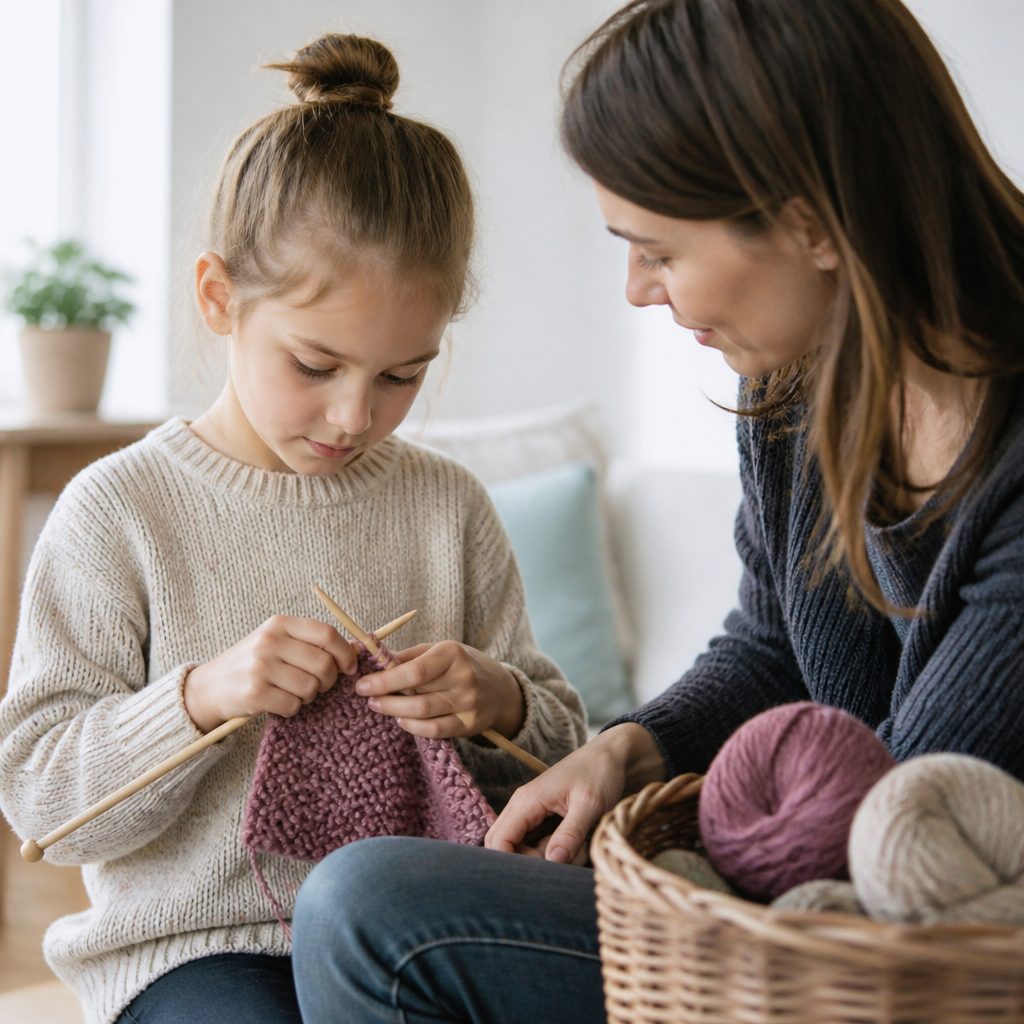
By making the project belong to the child rather than to a house. The same yarn lives in both places, in two wound cakes; the notebook page travels in the school bag; and each session ends with a photograph of the row counter, so the next session starts from a fact instead of a guess. A garter-stitch scarf or a square for a blanket is the right scale: small enough to finish, plain enough to restart.
The shared calendar, the school run between two addresses and the child's room kept in each house all benefit from the same habit: written down, in one place, without drama. A household that can keep a cardigan going across two kitchens can keep most things going.
Sources
For shared parenting weeks and what helps children between two homes, see the guidance at Family Lives.
One more page on the same question: what a ditty bag holds.